Having a child with special needs can be an emotionally, physically, mentally, and financially draining on a family. When diagnosed with a significant impairment like a genetic syndrome (e.g., Down Syndrome, Trisomy 13, XXX Syndrome, Marfan Syndrome), a congenital anomaly (e.g., Autism Spectrum Disorder, Cleft Lip/Palate, Encephalopathy, Spina Bifida, Encephalopathy), or an acquired syndrome (e.g., Traumatic Brain Injury, Cerebral Palsy, Aphasia) parents are inundated with doctor appointments and recommendations for therapies, medications, follow-ups, etc. In a perfect world, insurance would pay for everything recommended by a medical professional and we wouldn’t worry about the rising costs of said care. But, unfortunately that isn’t our reality.
|
Do you ever wonder what happens inside your mouth when you speak or swallow? While we all take for granted that we have the ability to speak (and swallow) A LOT of work happens behind the curtain. Our mouth (aka oral cavity) is where the sounds we hear are fine tuned using numerous muscles and other anatomy of the oral and nasal cavities. For kiddos sometimes these muscles and articulators simply do not want to cooperate which is usually why adults are unable to understand them or why they have difficulty efficiently chewing and swallowing their food. Speech-language pathologists evaluate the functioning of the mechanisms needed to produce intelligible (clear) speech sounds and ensure safe chewing/swallowing. They also are highly trained to provide treatment when these mechanisms are not efficient. Check out this video to see what our mouth looks like while we speak, sing, playing instruments, and swallow!
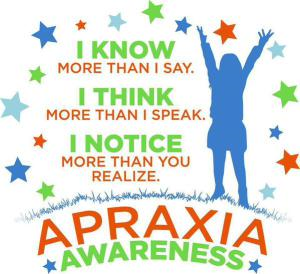 Childhood Apraxia of Speech (CAS) is a motor speech disorder. CAS is a relatively uncommon disorder (1-2 children per 1,000= 0.1-0.2%) and one of the lesser known disorders treated by Speech-Language Pathologists. There are some identified causes of CAS (e.g., stroke, trauma, chromosomal abnormalities) but we are not truly sure of all of the causes. In a nutshell: The child knows what he/she wants to say and the brain sends the message to the mouth (lips, jaw, and tongue) for appropriate placement to produce sounds, but the mouth doesn't cooperate. Keep Reading for information on Symptoms, Testing, Diagnosis, Treatment, and Resources
 Teaching our kiddos to use a zipper can be a difficult task. The truth is, it’s a very complex skill that encompasses many developmental areas! To zip a zipper up/down you must be able to motor plan, have bilateral coordination, display finger isolation, separate the two sides of the hand, have eye-hand coordination, have a strong pinch, and master the pincer and tripod grasps.
Looking for zipper tools? Try a zipper board, a clothing fastener vest, or a fun cargo vest with zippers for creative play and zipper practice. Questions? Ask one of our awesome occupational therapists or contact us to schedule an evaluation! Siblings of children with special needs have their own challenges. People who grow up with a sibling with special needs are often equipped with amazing qualities like patience, kindness, empathy for others, and loyalty, all amazing traits for anyone to have. Here are some terrific books to check out if you love a sibling of a child with special needs.
*Click on the desired book cover for more information* April is Occupational Therapy month! We want to take this opportunity to express our gratitude for our amazing occupational therapists and commend them for all they do! We also think this is a wonderful time to explain… What is Occupational Therapy?
 the Autism (aka ASD) is combined array (aka spectrum) of neurotypes. These neurotypes are natural variations. Autism itself does not require treatment, as it is not a sickness. But oftentimes Autistic individuals have co-occurring issues that decrease their ability to fully and effectively communicate their wants and needs or participate in acts of daily living. Autistics, just like neurotypicals, can range from non-speaking to speak eloquently and possess an extensive vocabulary. Knowing the characteristics of Autism is the first step to early identification and self empowerment.
Some characteristics of Autistic children are: Well, friends...it's about that time of year...to start planning for the summer months! We all know what that means...SUMMER CAMPS! It's often a challenge to find reliable and vetted summer programs for our special little ones...fortunately for us, our friends at AISD did the leg work for us! Click the photo below to download your copy. As always, if you have ANY questions feel free to email, call, or visit with me. 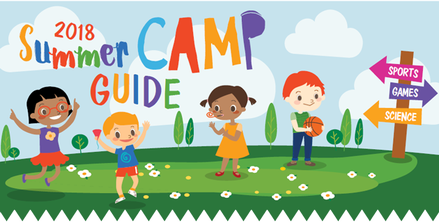  All of us at TCOB are heartbroken to hear of the ongoing events in Austin (and Schertz) with the explosive devices. We have a safety protocol that was established prior to these events and we will continue to honor those safeguards. There is no direct threat to our facility; however, we ask our families and our community to remain vigilant and aware of your surroundings. Please report any suspicious activity or packages/items to authorities immediately by calling 911. As these events continue to occur it is important that we educate our children and also find ways to talk to them about what is happening while not traumatizing them and making them fearful to step outside of their home. Our friends at The National Child Traumatic Stress Network published the following (unedited) document on how to talk to children about bombings. We though it was a good time to share with our families and those beyond our walls. Sending love to all those victimized.
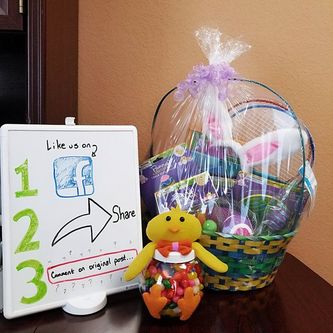 Guess how many jelly beans are in the jar and WIN this awesome Easter basket! The person that gets closest to the actual number will WIN!
We will announce the winner on our Facebook page 03/27/2018. This basket is packed full of classic books, sidewalk chalk, bunny popper ball, Easter straw, bubbles, egg dye kit, and much more (NO CANDY)! To enter: Like us on FB, Share the post, and post your guess on the original post! What are you waiting for???...Get guessing!  March is Trisomy awareness month, so it’s a perfect time to explain “what is trisomy?” Most people have 23 pairs of chromosomes, for a total of 46 chromosomes total. Trisomy is a genetic disorder in which an individual has an extra chromosome (partial or whole). Early identification is important in order to best evaluate, treat, and monitor for any possible developmental deficits or possible medical complications. Educating others of trisomy is important to not only provide a better understanding of the syndromes but to reinforce the notion that early intervention is vital for academic and social success.
Most common Trisomy disorders: Narrative language skills are vital to a person’s ability to not only have successful social relationships but also impact academic work (e.g., written language). Narrative skills are the ability to use language to tell a story. These skills begin to develop at the young age of 2 years! As a child’s narrative language skills develop they will begin to follow rules of storytelling (e.g., sequencing events, including characters, having an event/dialogue/solution, and an ending). Narratives may be fiction or non-fiction.
What should your child be doing? Check out this chart of narrative development.  The term “stutter” is terribly outdated and oftentimes negatively viewed, rather I like the term “dysfluent speech.” It is important to remember that we all have moments of dysfluent speech, that doesn’t necessarily mean we all need speech-language therapy to address it. The line that we draw to determine if therapy is recommended is the impact the dysfluent moment have on one’s life, the severity/ frequency/duration of dysfluent moments, and the accompanying tension with the dysfluent moments.
Some of the most common types of dysfluent speech include:
For many children with Dysgraphia, just holding a pencil and organizing letters on a line is extremely challenging. Many struggle with spelling and putting thoughts on paper. It is important that we remember Dysgraphia is not “laziness” or “sloppiness,” using these terms in from of your child with Dysgraphia can negatively impact their self-esteem and increase their anxiety resulting in refusal to write. Many children diagnosed or suspected of having Dyslexia also exhibit symptoms of Dysgraphia. Symptoms of Dysgraphia include:
Do you have your tickets to the Day Out With Thomas yet? Don't worry, we have you covered! We have TWO tickets to this awesome event we will give away this Friday (September 29, 2017) at noon. Want to throw your name in the drawing? All you have to do is write a review for TCOB on Google, Facebook, Yahoo, etc. Each review that gets posted gets entered to win (This means you can be entered several times if you post on different sites)! 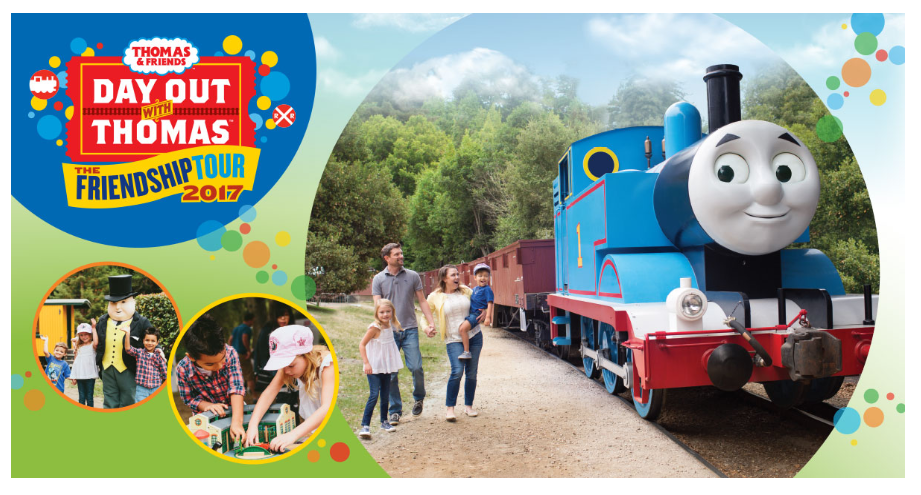 DAY OUT WITH THOMAS TICKET includes a scheduled 25 minute train ride (October 1, 2017 at 11am) behind Thomas the Tank Engine, all day admission to the Day Out With Thomas events at the Burnet Community Center, and the following activities:
**The winner will be announced via our Facebook page and the winner MUST pick up their prize by 6pm Friday September 29, 2017 at our office location (photo identification MUST match the name of the person shown online as the reviewer).** Don't we all want to give a synopsis of our kiddos for their teacher/s at the beginning of the school year? Basically give them a resume of likes/dislikes/what works and doesn't? Well, you are NOT alone! We made this handy PDF to fill in the blanks and even add a photo of your child. When you meet the teacher/s, aides, therapists, or even babysitters just hand them this "All About Me" page so they are sure to know all about your kiddo. Download is available for FREE, just click the Download File button below and start filling in the blanks! 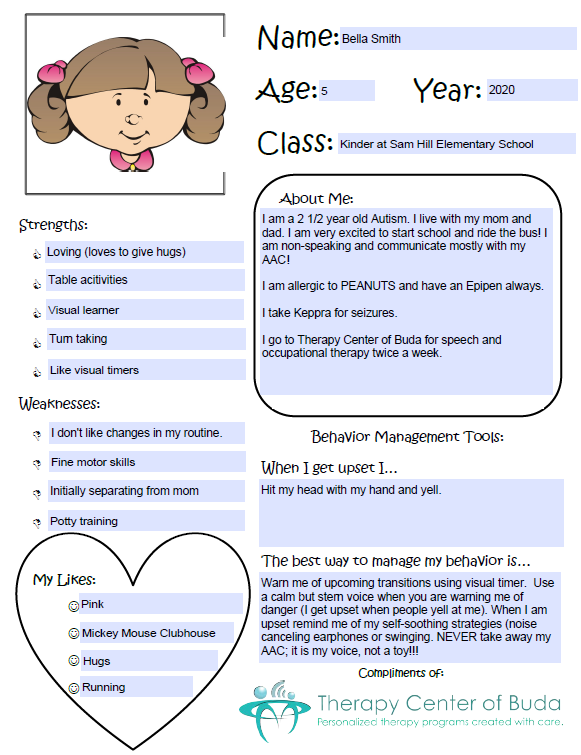 
|

AuthorAmy Grant is a licensed Speech-Language Pathologist, Certified Autism Specialist and Clinic Director of Therapy Center of Buda. 
Family Corner Blog
Learn parenting tips, access credible resources on disabilities and find out how to bring therapy techniques home with you to make parenting a little bit easier. Legal Disclaimer Categories
All
SubscribeArchives
March 2023
|
||
 RSS Feed